
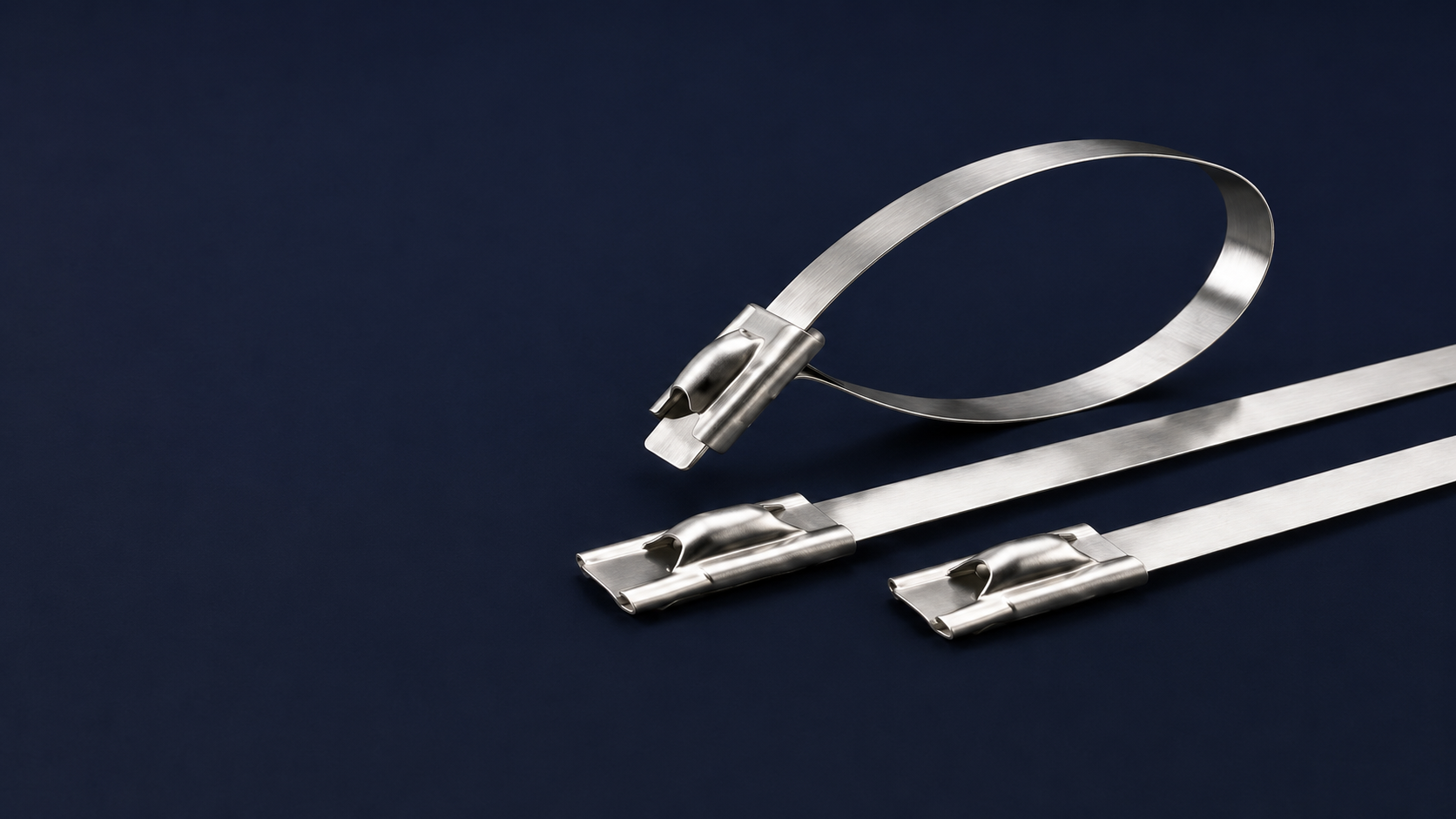
The Small Component That Protects a Critical System
In an oil field, refinery, petrochemical plant or offshore facility, cable routing is exposed to conditions that ordinary commercial installations rarely face. High ambient temperatures, salt-laden air, hydrocarbons, chemicals, vibration, ultraviolet exposure and long maintenance intervals can all affect a fastening system.
A cable tie may be a small part of the bill of materials, but its failure can allow cables, hoses or identification elements to move, sag or contact adjacent equipment. That is why project engineers and procurement teams evaluate the complete fastening system: material grade, width, length, locking method, coating, installation tool and documented performance.
Why the Kuwait and GCC Market Needs Harsh-Environment Fastening
Kuwait’s operating environment combines desert heat, airborne dust and coastal salinity. The wider GCC adds offshore platforms, LNG and gas-processing plants, refineries, power stations, desalination facilities, ports and renewable-energy sites. The exact exposure differs by location, but the common requirement is dependable performance over a long service life.
Current regional investment reinforces this need. Kuwait has announced plans to develop offshore discoveries and raise production capacity, and Saudi Aramco continues to expand major gas-processing infrastructure. These developments do not prove demand for any single cable-tie model, but they show why corrosion-resistant industrial cable management remains commercially relevant across the region. For sourcing guidance, see B-Tec as a stainless steel cable tie manufacturer and exporter for Kuwait and GCC.
Why Stainless Steel Is Considered
Stainless steel cable ties are selected where nylon ties may not provide the required combination of mechanical strength, temperature tolerance, fire behaviour, chemical resistance or long-term weathering performance. Metallic ties are commonly evaluated for cable bundling, support, fastening, signs and markers, insulation systems and equipment identification.
IEC 62275:2022 covers metallic, non-metallic and composite cable ties used to manage or secure wiring systems in electrical installations. Project specifications may also call for additional tests or approvals. Buyers should therefore request the applicable product datasheet and certificates instead of assuming that every stainless steel tie has identical performance. Current documents are available on B-Tec’s downloads and datasheets page, and published approvals are listed under certifications.
Where Stainless Steel Cable Ties Are Commonly Specified
Typical GCC applications include cable and conduit bundling on trays; securing cables around pipes and structural members; attaching identification tags; fastening insulation or protective covers; supporting instrumentation and control cabling; and outdoor telecommunications, utilities and transport infrastructure.
For oil and gas work, selection should be based on the real exposure zone. A tie inside a protected control room does not face the same corrosion risk as one near a coast, chemical process area, cooling-water system or offshore deck.
Five Specification Decisions That Matter
1. Material Grade
SS304 is widely used for general corrosion-resistant applications. SS316 is normally considered where chloride, marine or more aggressive chemical exposure raises the corrosion risk. The project’s material specification remains the controlling requirement.
2. Coated or Uncoated Construction
A polyester-coated tie can provide a barrier between the metal and the cable jacket and may improve handling. An uncoated tie may suit applications that prioritize bare-metal temperature performance or a compact profile. Coating limits must be checked separately.
3. Strength and Dimensions
Width, thickness, length, minimum loop tensile strength and maximum bundle diameter must match the load and installation geometry. Selecting only by length is not enough.
4. Locking Mechanism and Installation
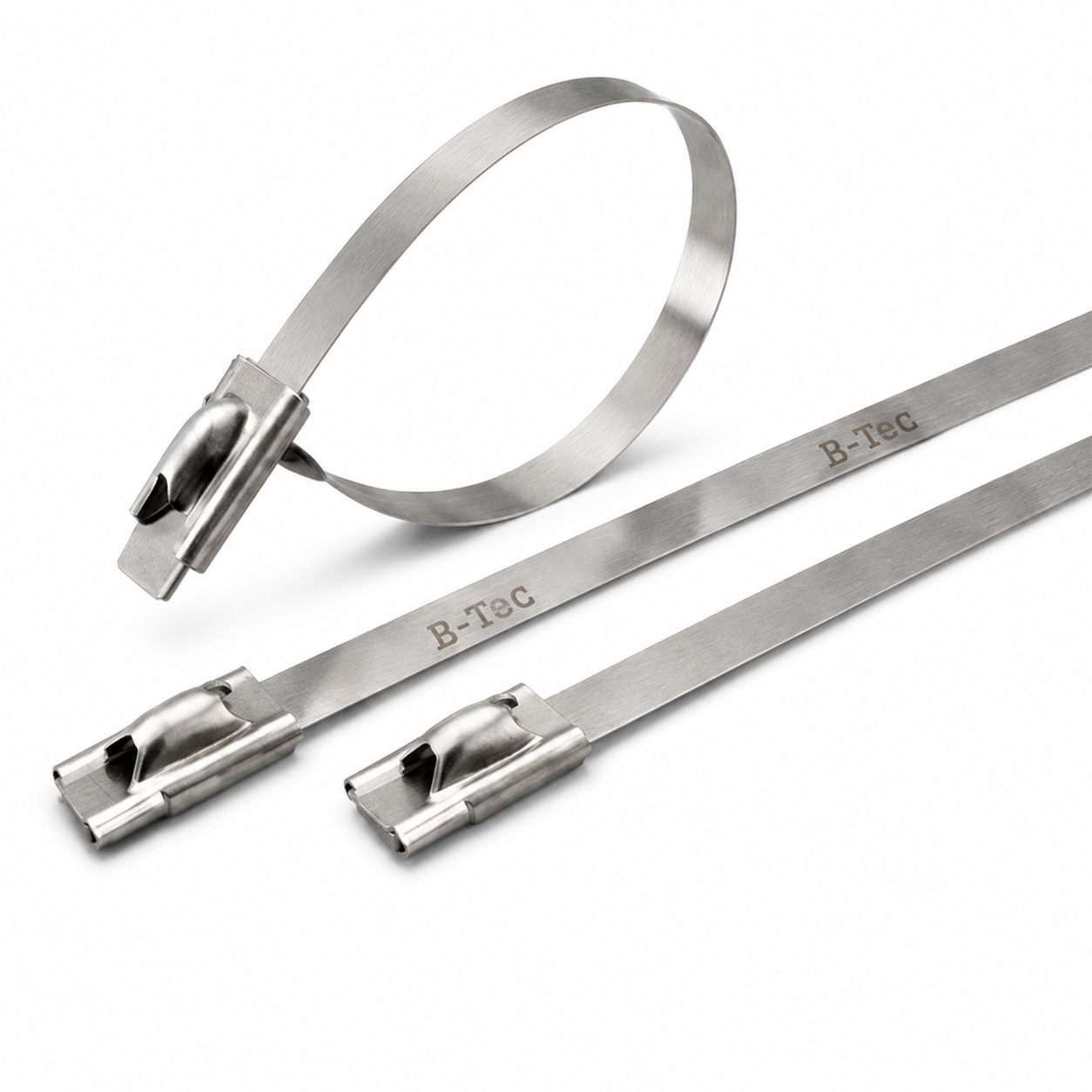
Self-locking roller-ball designs can speed installation, but consistent tension and a clean cut depend on the correct tensioning/cutting tool and trained installation practice. Explore B-Tec’s roller ball lock stainless steel cable ties.
5. Compliance and Traceability
Request the current datasheet, material grade, test standard, country-of-origin information and any project-required approvals. Do not treat a logo or general marketing claim as a substitute for model-specific documentation.
Why SS316 Is Frequently Discussed for Coastal and Offshore Zones
The main practical distinction is resistance to chloride-related corrosion. SS316 contains molybdenum, which generally improves resistance to pitting in chloride environments compared with SS304. That makes SS316 a common consideration for marine, offshore, coastal and chemically aggressive locations.
This does not mean SS316 is automatically required everywhere. Indoor, sheltered or less aggressive zones may permit SS304 when the project specification and lifecycle assessment support it. Correct selection balances exposure, required life, inspection frequency, consequence of failure and total installed cost.
Installation Quality Is Part of Product Performance
Even a correctly specified tie can perform poorly if it is overtightened, left with a sharp tail or installed over a vulnerable cable jacket without considering edge protection. A suitable tensioning tool helps installers apply repeatable tension and cut the excess strap cleanly.
Before bulk installation, the contractor should verify cable-jacket compatibility, bundle diameter, tool setting, tail finish and required spacing. Inspection records are especially valuable on critical industrial systems.
A Practical Procurement Checklist
Before requesting a quotation, provide the application, country and project type; indoor, outdoor, coastal, offshore or chemical exposure; required stainless-steel grade; coated or uncoated preference; tie length, width and bundle diameter; required tensile or loop-strength value; operating-temperature requirement; applicable standard or approval; quantity and packaging; and the required installation tool.
A complete enquiry helps the manufacturer recommend the correct product faster and reduces substitutions based only on price.
Conclusion
For Kuwait and GCC projects, stainless steel cable ties are not simply a stronger version of a plastic tie. They are engineered fastening components whose grade, coating, size, locking design and installation method should match the exposure and project specification.
B-Tec Innovations manufactures stainless steel cable-tie solutions for demanding industrial applications. Share your application, environment, required grade, dimensions and project documentation needs with the B-Tec team to identify the appropriate product and obtain the latest datasheet.
Frequently Asked Questions
Are stainless steel cable ties suitable for Kuwait’s outdoor climate?
They can be suitable when the material grade, coating, dimensions and product ratings match the heat, UV, dust, salinity and mechanical conditions of the installation. Confirm the current model-specific datasheet.
Should oil and gas projects use SS304 or SS316 cable ties?
The answer depends on the project specification and exposure. SS316 is commonly considered for chloride-rich, coastal, offshore or aggressive chemical conditions; SS304 may suit less aggressive environments.
Why use a cable-tie tensioning tool?
A compatible tool supports repeatable tension and a controlled cut, improving installation consistency and reducing sharp or excessive tails.
Does IEC 62275 apply to stainless steel cable ties?
IEC 62275:2022 specifies requirements for metallic, non-metallic and composite cable ties and associated fixing devices used in electrical installations. Confirm which B-Tec models and classifications are covered by current documentation.
Need the Right Stainless Steel Cable Tie for a Kuwait or GCC Project?
Share the application, grade, dimensions, environment, required standard and quantity with B-Tec Innovations. Request the latest catalogue, datasheet or quotation.
You can also contact B-Tec with your technical requirement.