
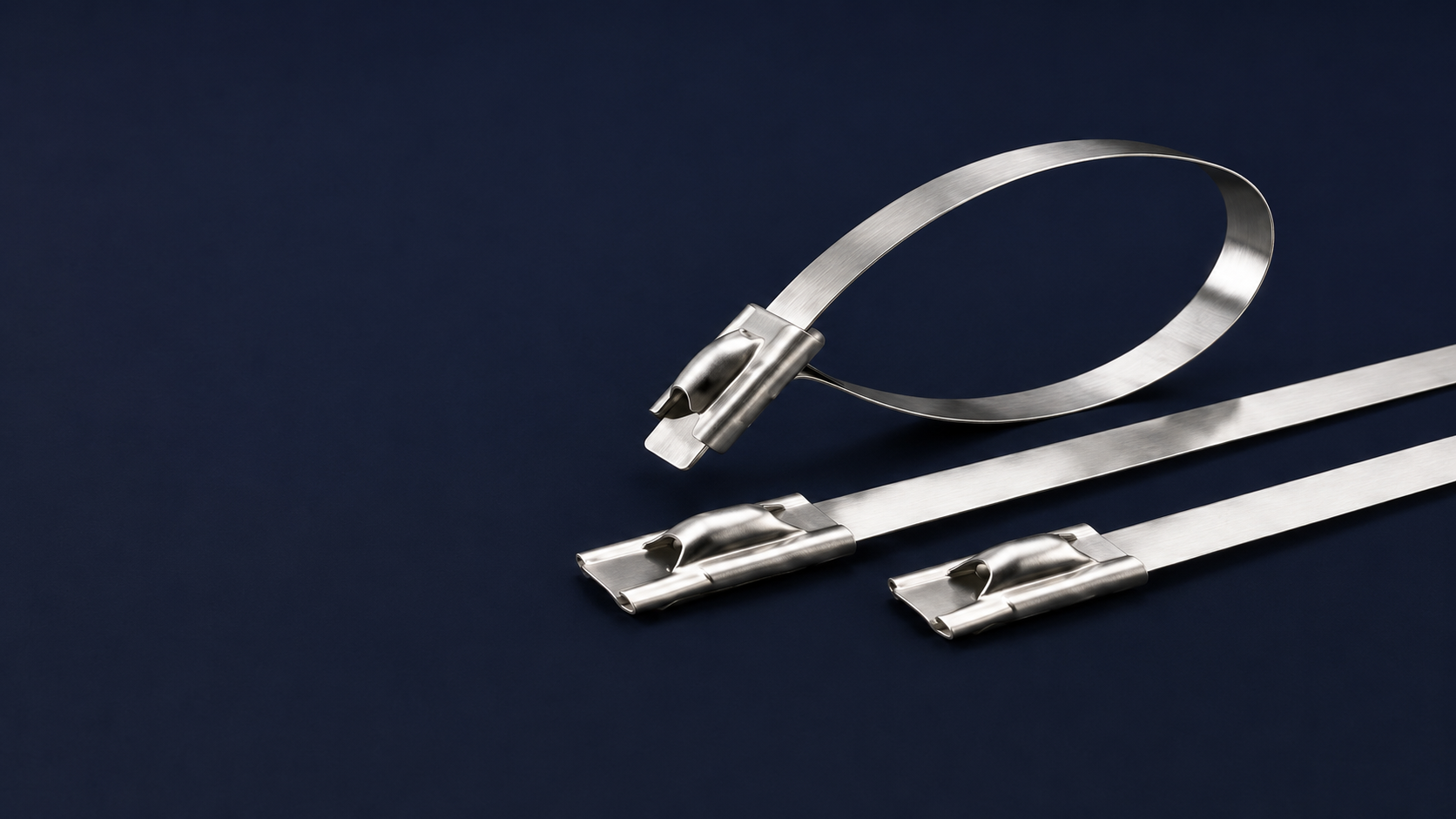
The Practical Difference
SS304 and SS316 are both austenitic stainless-steel grades used for corrosion-resistant fastening. The most important selection difference is that SS316 includes molybdenum, which generally provides better resistance to pitting and crevice corrosion in chloride-containing environments.
For Kuwait and GCC projects, that distinction matters because many installations are close to the sea, exposed to salt-laden air, cooling water or aggressive industrial chemicals. SS316 is therefore commonly evaluated for coastal, marine, offshore and chemical-service locations. SS304 remains a practical option for many indoor, sheltered and less aggressive environments when permitted by the specification.
Why “Stainless” Does Not Mean “Cannot Corrode”
Stainless steel depends on a thin passive oxide film for corrosion resistance. Chlorides, deposits, crevices, contamination, temperature and prolonged wetness can disrupt local protection. A cable tie may also sit tightly against a surface where moisture and salts remain trapped.
Selection should therefore consider the micro-environment at the fastening point, not only the country or city. Two ties on the same project can experience very different service conditions.
When SS304 Can Be the Right Choice
SS304 cable ties may be appropriate for indoor electrical rooms, protected plant areas, general manufacturing, sheltered commercial infrastructure and other locations with limited chloride or aggressive chemical exposure.
The advantages can include broad availability and lower material cost. However, the purchase price should be compared with inspection, replacement access, shutdown risk and the consequence of failure. SS304 should not be selected only because the installation is technically onshore; coastal air and wash-down practices may still create chloride exposure.
When SS316 Should Be Considered
SS316 is commonly considered for offshore platforms, ports, coastal industrial facilities, marine equipment, desalination plants, chloride-bearing process zones, cooling-water systems and chemically aggressive environments.
It is often called marine grade in commercial usage, but that label is not a complete specification. Buyers should request the actual grade, product code, mechanical rating and applicable test documentation.
Kuwait and GCC Exposure Scenarios
Coastal and Offshore
Salt spray and airborne chlorides support the case for SS316, subject to the project’s corrosion assessment.
Refineries and Petrochemical Plants
The correct grade depends on the chemical zone, temperature, deposits, cleaning regime and consequence of failure. Different units may require different materials.
Power, Utilities and Infrastructure
Outdoor heat and UV are important, but corrosion category, industrial pollution and proximity to the coast also matter.
Solar Installations
Long outdoor life, heat cycling, UV exposure and maintenance access influence the complete tie selection. Grade, coating, mechanical load and cable protection should be reviewed together.
Indoor and Sheltered Systems
SS304 may be sufficient where chloride and chemical exposure are controlled, provided the approved material specification permits it.
Grade Is Only One Part of the Specification
Two SS316 ties can have different performance if their width, thickness, edge finish, locking mechanism, coating, manufacturing quality or test classification differs. Likewise, an oversized tie is not automatically safer if it is installed incorrectly.
A complete schedule should state material grade; coated or uncoated construction; dimensions; minimum loop tensile strength; bundle range; temperature rating; locking style; edge condition; installation tool; applicable standard; and documentation and traceability requirements. Explore B-Tec’s roller ball lock stainless steel cable ties for the published range.
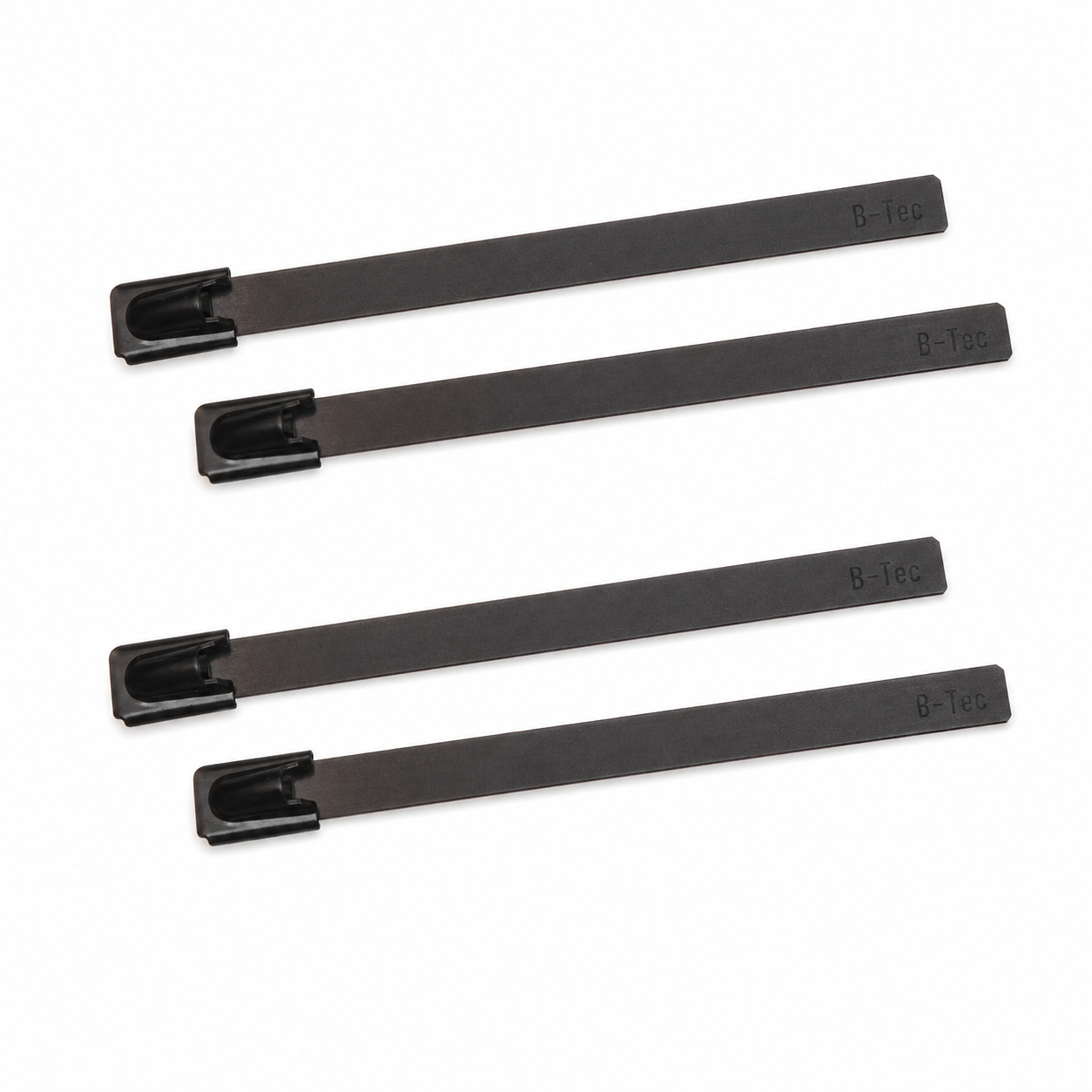
How Coating Affects the Grade Decision
A polyester coating can help separate the metal from the cable jacket and add a protective barrier. It does not eliminate the need to choose the correct stainless-steel grade. The locking head, cut end or damaged coating may expose metal, and the coating itself has temperature and chemical limits.
Treat grade and coating as two separate decisions: first choose the base material for the corrosion environment, then choose coated or uncoated construction for cable protection, handling and other functional requirements.
Procurement Questions to Ask
What is the actual material grade for the strap and locking head? Is the grade supported by the current datasheet or certificate? What loop tensile strength applies to this exact size? Which IEC 62275 classification or other approval applies to this model? What is the rated temperature range for the complete product? Is the coating full or partial, and what is its material? Which installation tool and setting are recommended? Can the supplier provide consistent product identification and batch traceability where required?
These questions reduce the risk of receiving a product described only as a generic “metal cable tie.” Current documents are available on B-Tec’s downloads and datasheets page, and published approvals are listed under certifications.
A Simple Selection Rule
Use SS304 as a candidate for general, sheltered and lower-corrosion environments when the project specification permits it. Use SS316 as a candidate for chloride-rich, coastal, marine, offshore or more chemically aggressive environments. Escalate the decision to the project materials or corrosion engineer when exposure is severe or failure is critical.
This is a screening guide, not a substitute for the approved project specification. For a wider view of harsh-environment selection, see our guide to stainless steel cable ties for Kuwait and GCC oil and gas projects.
Conclusion
The SS304-versus-SS316 decision is fundamentally a lifecycle and exposure decision. Kuwait and GCC buyers should look beyond the initial unit price and specify the grade that matches the real operating environment.
B-Tec Innovations offers stainless steel cable ties in SS304 and SS316, with coated and uncoated options across the published range. Contact the B-Tec team with your project location, exposure, size, strength and documentation requirements for product selection support.
Frequently Asked Questions
Is SS316 always better than SS304?
SS316 generally offers better resistance in chloride-rich environments, but it is not automatically necessary for every installation. The correct choice depends on exposure, service life, criticality and project requirements.
Which grade is suitable near the sea?
SS316 is commonly considered for coastal and marine exposure because of its improved chloride resistance. A project corrosion assessment should confirm the final choice.
Can SS304 be used outdoors in Kuwait?
Possibly, in a sheltered or lower-corrosion environment where the project specification permits it. Outdoor exposure alone does not define the answer; salinity, deposits, wetness, pollution and maintenance conditions matter.
Does SS316 remove the need for inspection?
No. Correct grade selection reduces risk but does not eliminate the need for installation inspection and lifecycle maintenance, especially in critical or aggressive environments.
Need the Right Stainless Steel Cable Tie for a Kuwait or GCC Project?
Share the application, grade, dimensions, environment, required standard and quantity with B-Tec Innovations. Request the latest catalogue, datasheet or quotation.
You can also contact B-Tec with your technical requirement.